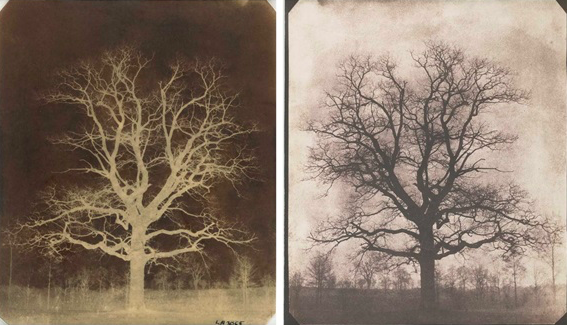
William Henry Fox Talbot began his pathway in photography in 1834. It wasn’t until 1839 when Jacques Mandé Daguerre created his daguerrotype that he began to take more of an interest in the subject. In 1841, Talbot contacted the patent office to have his prototype patented. He named it the calotype. The calotype was one of the first negative-process machines that permitted the copying of the same image multiple times. This was possible by having a translucid negative wax on the silver chloride paper. A second sheet of paper was then covered in the same silver chloride solution and when exposed to the translucid negative the final result was then developed.
Example of the type of images created from the calotype
Skip ahead to 1839 and a man named Hippolyte Bayard (1801-1887) was next in line to create a useful technique for the technology behind photographs. Another Frenchman, amongst the many before him, Bayard devised a way to have images be placed directly on piece of paper. His process was relatively simple, a sheet of paper would be covered in a solution of silver chloride where it then would be blackened by light. After this, the paper is exposed to the camera device where a solution of silver iodide sensitizes the image. This exposure lasts roughly between 30 minutes to 2 hours. His friend, Jacques Mandé Daguerre, who invented the daguerrotype is known to have convinced Bayard to not submit his findings of his new inventive process of handling images. In 1840 however, he argued his case and this surge of passion for photography an be regarded as one of the first political-esque protests regarding the subject.
The corpse which you see here is that of M. Bayard, inventor of the process that has just been shown to you. As far as I know this indefatigable experimenter has been occupied for about three years with his discovery. The Government, which has been only too generous to Monsieur Daguerre, has said it can do nothing for Monsieur Bayard, and the poor wretch has drowned himself. Oh the vagaries of human life…!
Unfortunately, Nicéphore Niépce passed away in 1833 and his partner in crime, Louis Jacques Mandé Daguerre invented his own prototype five years later in 1838. This “daguerreotype” had a very similar concept to that of Niépce’s. A silver plate would be exposed to the camera where then mercury vapors would interact with the silver iodide coating on the plate to lament the image on the plater after being exposed to light. This finding led Daguerre and many other members within this community to idealize this into the overall concept of light exposure. Daguerre’s prototype’s exposure to light took less than 30 minutes for the image to develop. After the final image is set he would touch it up with salt water.
A variety of different methods have been developed over the last two centuries photography has been around. In 1824, Nicéphore Niépce developed a machine that would project an image onto a silver plate after a few days of being exposed to light. After years of perfecting his concept, Niépce and his fellow colleague Jacques Mandé Daguerre in 1832 paired their current methods with lavender oil residue to quicken the process in which photographs would develop. Now instead of a few days, they were able to see the developed image in a matter of one day.
“I must now do three things: (1) give more sharpness to the representation of the subject; (2) transpose the colors; and (3) fix them permanently, which will not be the easiest of the three.”
I am writing to all of you to inform you that this blog is about the history of photography and its future. Then, I will branch out little by little and connect the essence of Photoshop and its social impact.



 Health-Ade Photography